Green Glasses Testing Dashboard
Comparing transmission curves, cone activation, and melanopic response across 8 lens types
Welcome, Sci-Fam!
Green light might help lower the frequency and severity of migraines, according to research from the last few years that I covered in a recent video series. It works both because the green cones in our eyes send the lowest amplitude signal to our brain (important when said brain is oversensitized), and because the green light itself seems to trigger the production of our body's natural opioids, which can help to reduce pain.
The problem is, in order to get the greatest benefit from the green light, the evidence indicates that you need to sit in a room lit only with dim green light for a period of one to two hours per day. Most of us don't have time for this, which led to many of you asking the question "What if we just wear green-tinted glasses?"
From a pure physics perspective it shouldn't matter if green light starts off green or becomes green by passing through a filter. But, practically, not all filters filter out all of the blue and red light that gets picked up by our blue and red cones in the eye. So, I set out to test this by ordering the top six green glasses off of Amazon as well as getting two sets of tinted contact lenses. I then tested them by setting up a full spectrum white LED and using a high-end spectrometer to measure the initial wavelengths of light produced by the white light and the wavelengths that get through each lens. And because I'm a big nerd, I couldn't just tell you the results in a brief summary. Instead I had to build a fully interactive dashboard for you to browse through the testing results yourself.🤓 I will hopefully be adding to this page as I test more devices. If you want to be notified of updates as well as occasional giveaways and to get some other fun science, sign up here for my free newsletter.
I've got leftover green lights & glasses from my testing that need a new home! Newsletter subscribers only will be entered to win. 🎁
Test Overview
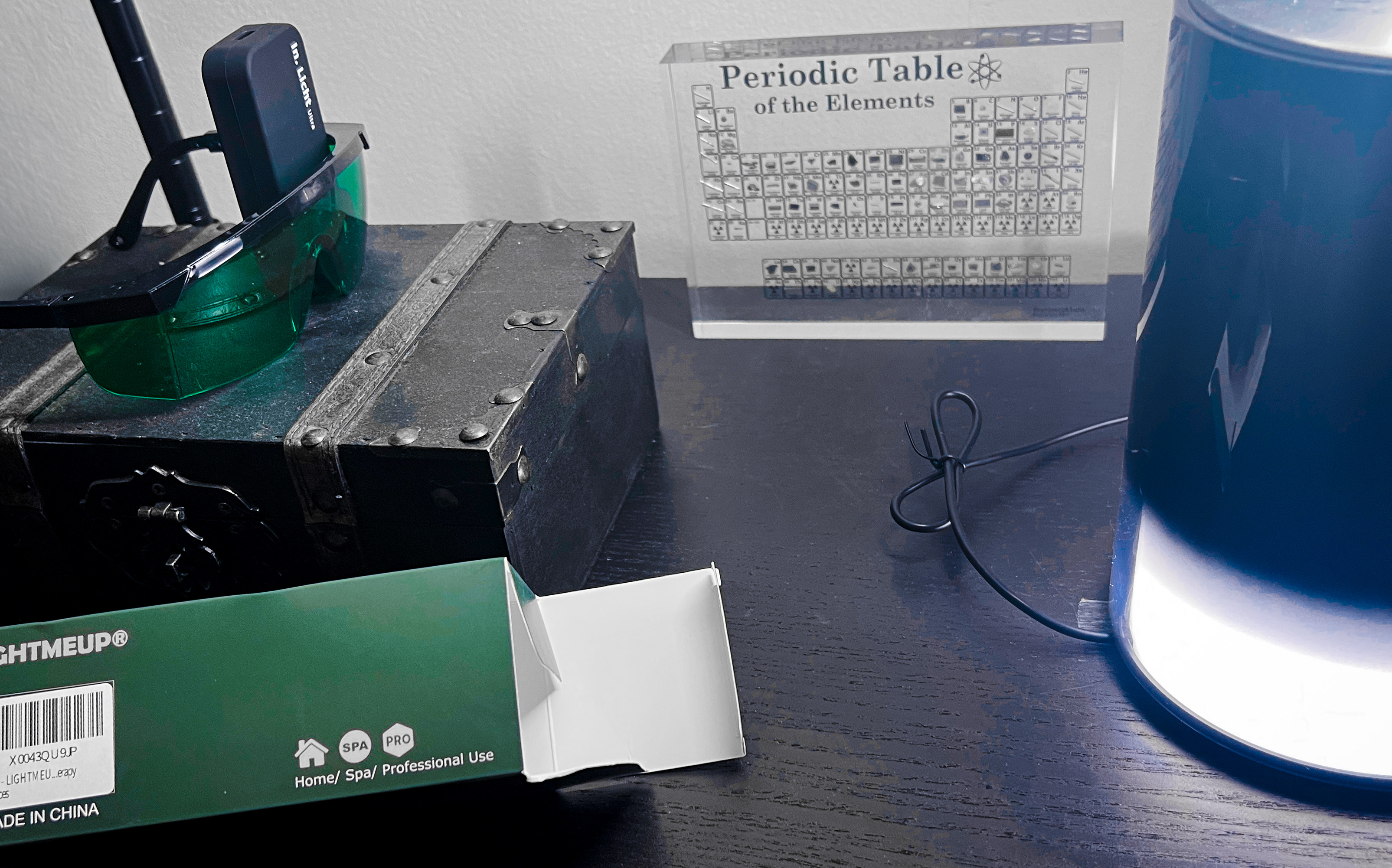
I started off with the Govee Floor Lamp 2, because it has some of the best white LEDs that I've tested while still maintaining the peak in the blue region that is characteristic of standard white LEDs ( I could have used one of the super high-end ones that evens out this peak but that's actually less realistic for most of your at-home lighting set ups.)
I then used the In.Licht Ultra spectrometer to measure the wavelengths of light from the white light and then for what passed through each lens. Rather than block off the peripheral sides of the glasses to test just the filter itself, I intentionally left the same sort of gaps that you would get from wearing the glasses so that it would be a more realistic picture of the lighting your eyes would experience
Testing Setup
Glasses Tested
| ID | Product Name | Price | Link |
|---|---|---|---|
| LMUD | LIGHTMEUP Red Light Therapy Glasses | $6.99 | Amazon |
| LMU2 | LIGHTMEUP Red Light Therapy Glasses Deep Green | $6.99 | Amazon |
| YL | OLINOWL Oversized Square Rimless Sunglasses Tinted | $7.69 | Amazon |
| CT | PURPLE CANYON Green Color Therapy Mood & Migraine Glasses | $13.99 | Amazon |
| CTFX | GloFX Green Color Therapy Mood Glasses Migraine Glasses | $15.99 | Amazon |
| VVS | VIVOSUN Indoor Hydroponics LED Grow Room Glasses with Glasses Case | $15.18 | Amazon |
| Altius Red | ALTIUS® Amber Performance Soft Contact Lens | — | Altius Vision |
| Altius Green | ALTIUS® Grey-Green Performance Soft Contact Lens | — | Altius Vision |
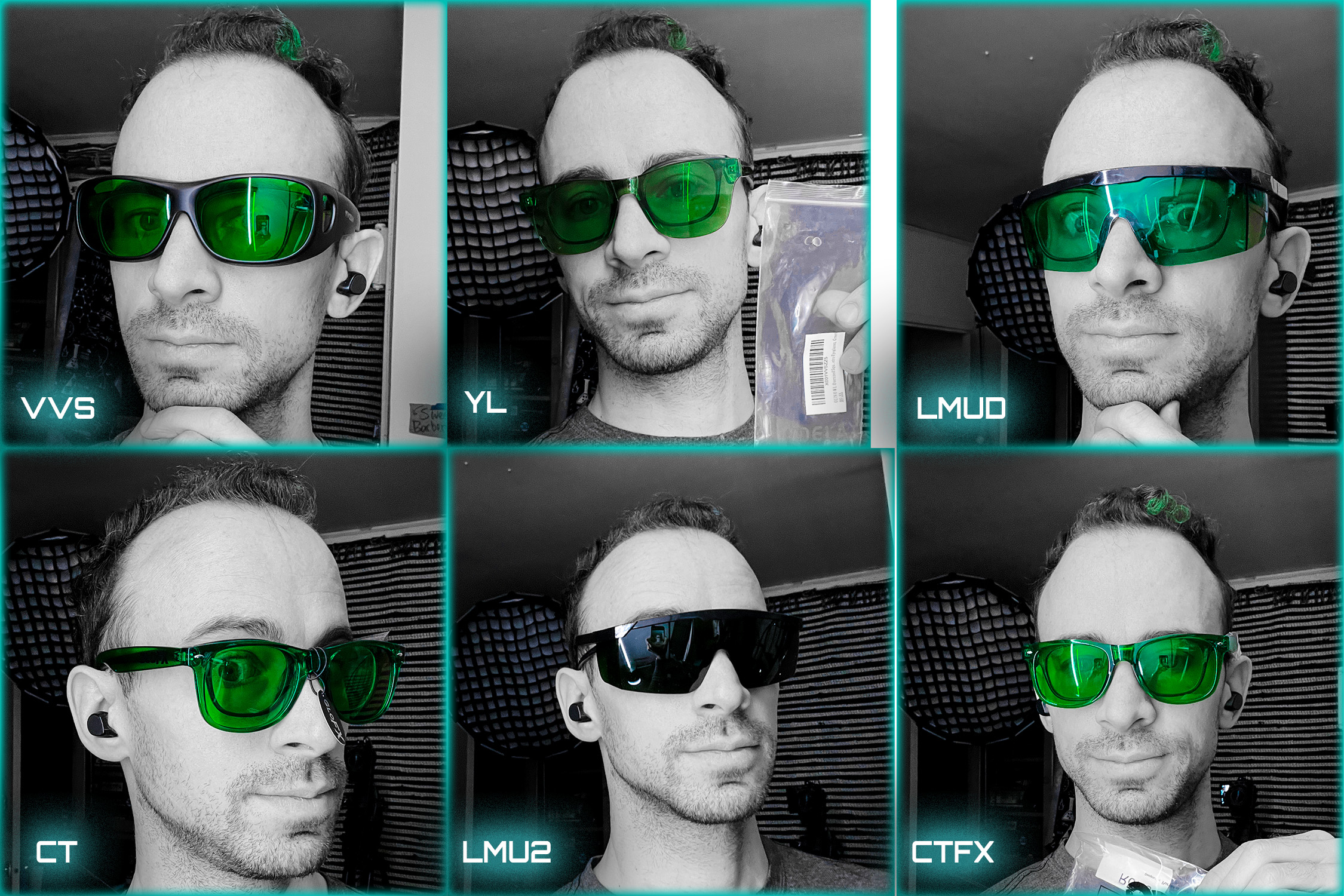
All 6 pairs of glasses tested, shown with their dashboard IDs
Disclosure: Amazon links above are affiliate links. Purchases may earn me ~$0.20. If 50 people fall for it, I can buy a snowcone!
Wavelength Visualizer
Explore what different wavelengths of visible light look like. The human eye can perceive light from approximately 380nm (violet) to 780nm (deep red).
Color approximations based on the work of Dr. Dan Bruton.
Spectral Transmission Curves
Understanding the Wavelengths:
- 380-450nm (Violet/Blue) — These wavelengths are often linked to migraine triggering. Good glasses for migraine relief should block most of this range.
- 500-570nm (Green) — Research suggests narrow-band green light around 525nm may actually reduce migraine intensity. Ideal glasses let this range through.
- 600-700nm (Orange/Red) — Some red light passes through certain lenses. This is generally neutral for migraines but affects how colors appear.
Pure Green Light Reference: The "Pure Green Light" dataset (highlighted in bright green) shows the same lamp set to pure green mode. Compare this to the glasses — you can see whether wearing green glasses in white light replicates the spectral profile of simply being in pure green light.
Transmitted SPD (Normalized)
Why It Matters: For green light therapy to work for migraines, you want lenses that:
- Significantly reduce the blue peak (around 450nm) compared to baseline
- Preserve as much of the green light (515-550nm) as possible
- The closer a colored line follows the baseline in the green zone while being lower in the blue zone, the better
Action Spectra Reference
Meet Your Photoreceptors:
- S-Cone (Blue) — Detects short wavelengths (blues/violets). Peaks around 445nm.
- M-Cone (Green) — Detects medium wavelengths (greens). Peaks around 540nm.
- L-Cone (Red) — Detects longer wavelengths (reds/oranges). Peaks around 570nm.
- Melanopic (Purple) — These are special cells called ipRGCs (intrinsically photosensitive retinal ganglion cells). They're NOT for seeing colors, but they regulate your circadian rhythm and are involved in light-triggered migraines. They peak around 480nm (blue-cyan).
- Rhodopic (Cyan) — Related to rod cells used for night/low-light vision. Peaks around 500nm.
Cone Activation (% of Baseline)
What the Cones Do:
- L-Cone (Red bars) — Primary for red color vision. Most glasses preserve these well.
- M-Cone (Green bars) — Primary for green color vision. For green light therapy, you want these to remain reasonably active.
- S-Cone (Blue bars) — Primary for blue color vision. These are also stimulated by wavelengths that may trigger migraines, so lower activation is often better for photophobia relief.
Melanopic & Rhodopic Response
Why Melanopic Matters for Migraines:
- Melanopsin-containing cells (ipRGCs) connect directly to pain pathways in the brain. Research by Dr. Rami Burstein at Harvard found these cells are the likely reason light hurts during migraines.
- These cells are most sensitive to blue-cyan light (~480nm), which is why blue light blocking may help.
- Interestingly, narrow-band green light (~520-530nm) may activate a different neural pathway that actually reduces migraine pain. Clinical trials showed a 60% reduction in monthly headache days.
Practical Takeaway: Lower melanopic % = potentially better migraine protection. The lenses with the lowest melanopic values (LMUD, LMU2) are blocking the wavelengths most linked to light sensitivity. However, too low may make everything too dark. Look for a balance — low melanopic activation while still being able to see clearly.
Comprehensive Comparison Table
| Glasses | Norm. Lux | Melanopic % | L-Cone % | M-Cone % | S-Cone % | S-Cone Block | M-Cone Pass | Red Pass | Score |
|---|
- Norm. Lux — Brightness after filtering. Higher = brighter image through the lens.
- Melanopic % — Activation of migraine-linked cells. Lower is better for light sensitivity.
- L/M/S-Cone % — How much each color receptor is stimulated. Lower S-Cone = better blue blocking.
- S-Cone Block — How much S-cone (blue) activation is suppressed (100% - S-Cone%). Higher is better for migraine prevention.
- M-Cone Pass — How much M-cone (green) activation is preserved. Higher preserves therapeutic green light.
- Red Pass — Percentage of red light allowed through. Higher values mean warmer color tint.
- Score — Overall ranking based on cone activation (weighted toward migraine relief).
- 40% weight — Melanopic suppression (how much those pain-pathway cells are blocked)
- 35% weight — S-Cone suppression (how much blue-sensitive cones are blocked)
- 25% weight — M-Cone preservation (how much green-sensitive cones remain active for therapeutic benefit)
Key Findings
- LMU2 (Green Light Therapy) — These deep green lenses block both blue AND red light, letting through only the narrow-band green that research suggests may reduce migraine pain. Best for dedicated therapy sessions, emulating the effect of a dim room lit with only green light.
- Altius Red (Everyday Use) — Contact lenses that block almost all blue light while preserving natural color vision. You'll still see greens and reds normally, making these ideal for daily wear and screen work (especially in the evenings).
- VVS (Budget Runner-Up) — An affordable alternative with solid blue blocking and reasonable color preservation. Great option if you want to try green-tinted glasses without a big investment.
Note: Both the VVS and LMU2 glasses feature side panels to ensure most of your peripheral vision is also filtered green, making them more effective than flat-lens styles.
The Science Behind Green Light Therapy:
Harvard Medical School research found that while blue, red, and amber light intensify migraine headaches, narrow-band green light (~520-530nm) was the only color that didn't worsen pain. In clinical trials, patients saw up to a 60% reduction in monthly headache days. The theory is that green light generates smaller electrical signals in the brain's pain center (the thalamus) compared to other colors, as well as triggering the production of endogenous opioids, which are natural painkillers.
Choosing Your Glasses:
- For active migraine attacks: Choose the lens with lowest melanopic response, even if visibility is reduced. In fact, lowering total light intensity can be actively helpful. Even green light should be dim.
- For daily prevention/screens: Choose a mid-range option that blocks enough blue but maintains comfortable vision and color production.
- For testing green light therapy: Look for the "Best M-Cone Pass" option combined with good S-cone blocking.
Stay Connected & Get Involved
Got a product you want me to test? Have questions about green light therapy or anything else science-related? I'd love to hear from you! Drop me a line at avisha@distilledscience.com
I've got leftover green lights & glasses from my testing that need a new home! Newsletter subscribers only will be entered to win. 🎁